
The Black Death
A devastating plague pandemic that killed up to half of Europe's population.

Jakub Hałun · CC BY-SA 4.0
It was one of the most fatal pandemics in human history, leading to the death of up to 50 million people, or 50% of Europe's 14th-century population. The disease spread primarily by flea bites, though also through contact with infected tissues or fluids and, in pneumonic cases, through respiratory droplets.
- type
- Pandemic
- caused_by
- Yersinia pestis
- location
- Europe, Middle East, North Africa, West Asia
- estimated_deaths
- Up to 50 million (30%–60% of European population, ~33% of Middle Eastern population)
- known_for
- Second plague pandemic; one of the most fatal pandemics in human history
Lore & Background
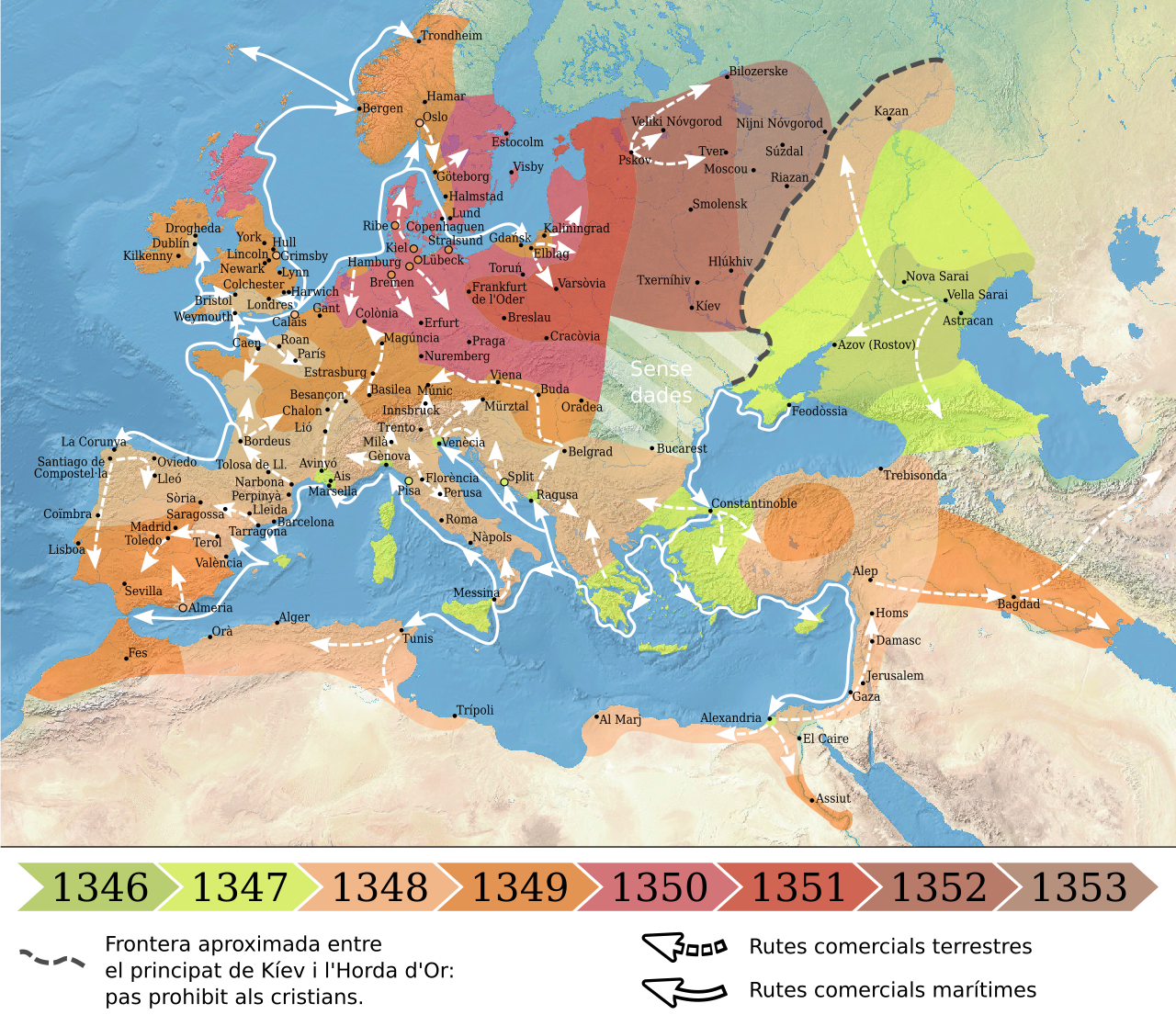
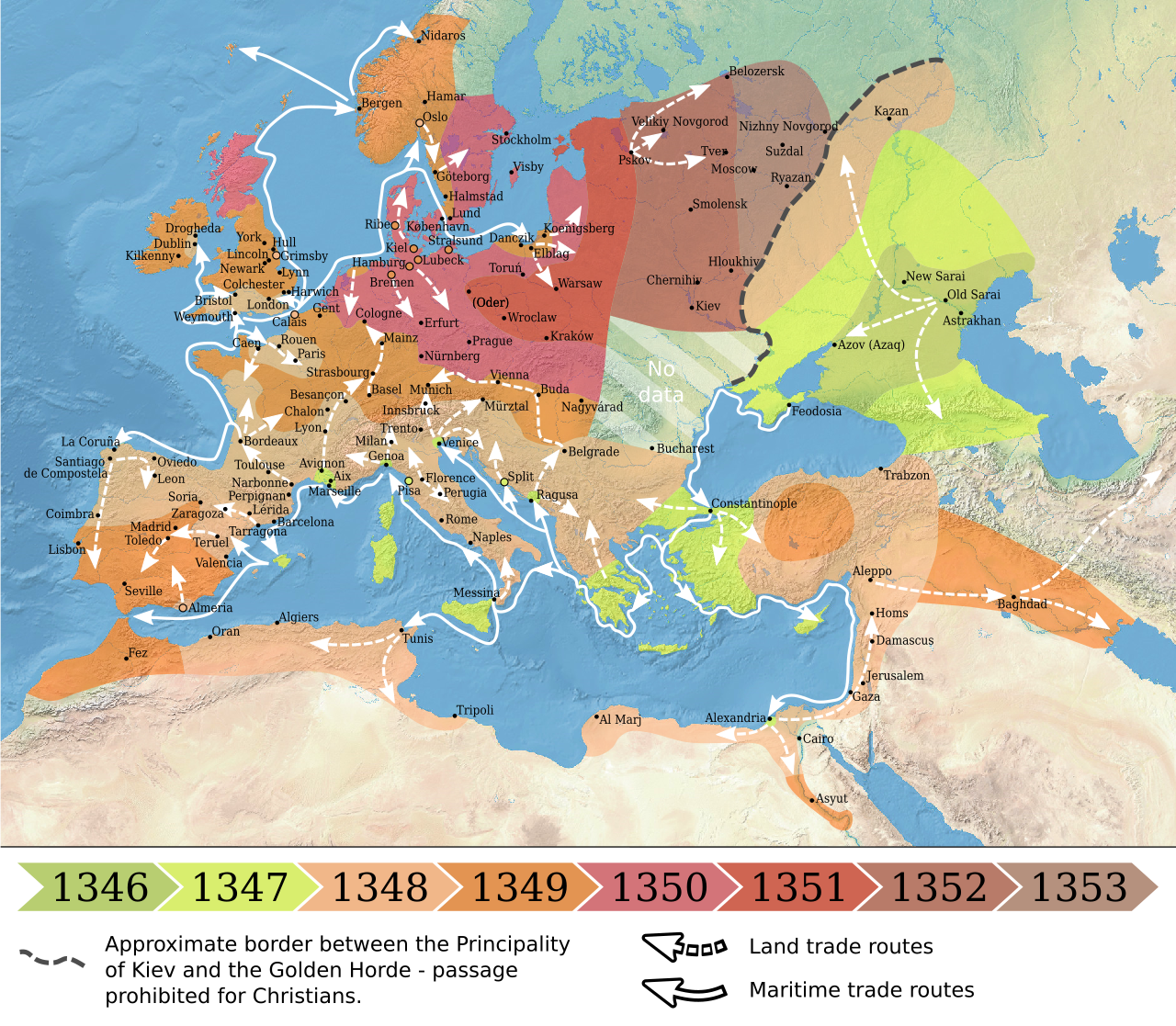
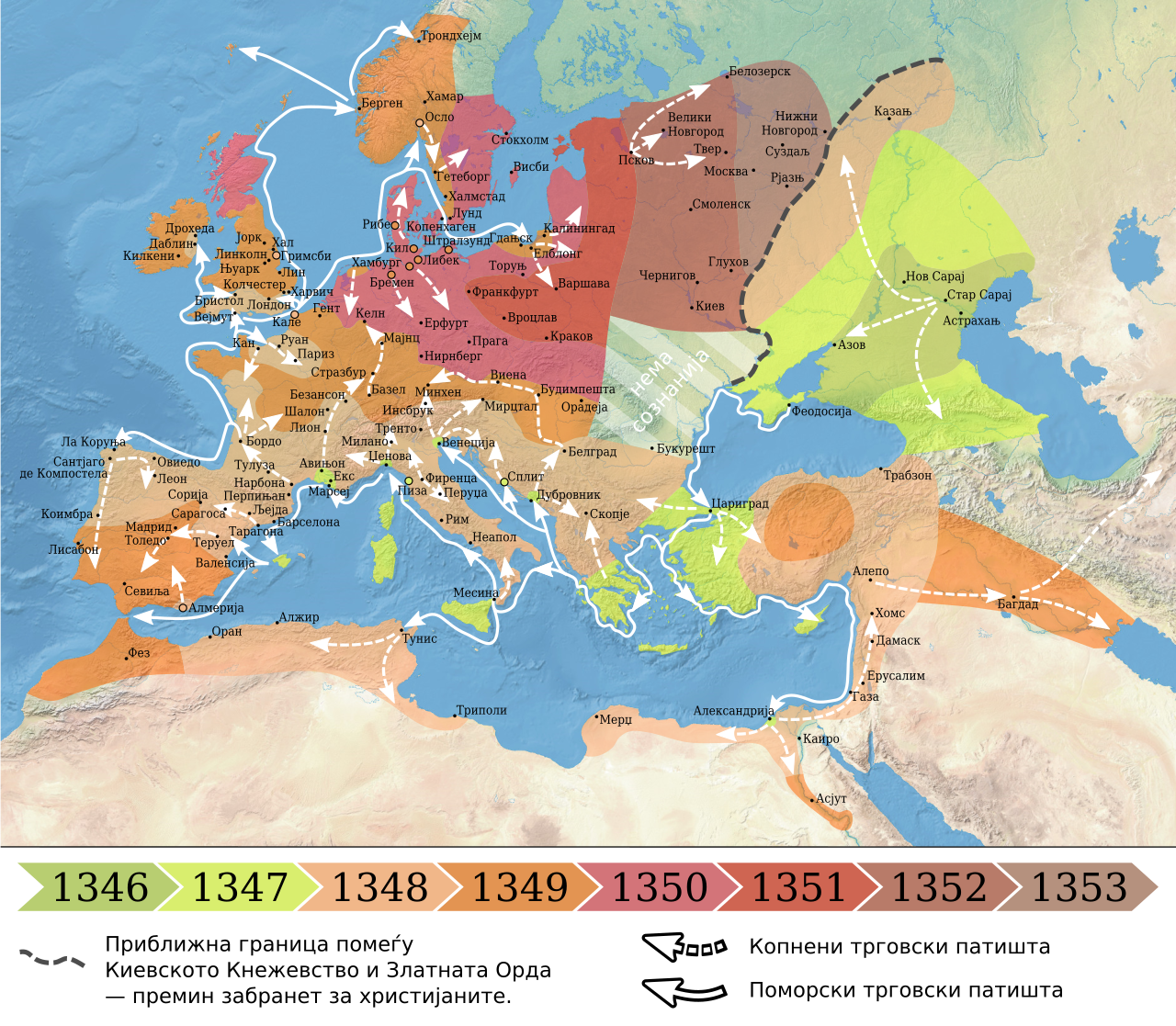
From Crimea, it was most likely carried by fleas living on black rats that travelled on Genoese ships, spreading through the Mediterranean Basin and reaching North Africa, West Asia, and the rest of Europe via Constantinople, Sicily, and the Italian Peninsula. There is evidence that once it came ashore, the Black Death mainly spread from person-to-person as pneumonic plague, explaining its quick inland spread.
Reader's Guide
The Black Death had far-reaching population, economic, and cultural effects. It is estimated to have killed 30% to 60% of the European population and approximately 33% of the Middle Eastern population. Due to the crisis of the late Middle Ages, the European population did not regain its 14th-century level until the 16th century. Outbreaks of the plague recurred around the world until the early 19th century. The term 'Black Death' was not used to describe this pandemic until the 1750s; earlier European writers called it 'pestilence', 'great pestilence', 'the plague', or 'great death'. The phrase 'black death' as a proper name was popularized by Swedish and Danish chroniclers in the 15th and early 16th centuries. The immediate territorial origins of the Black Death remain unclear, with evidence pointing towards Central Asia, China, the Middle East, and Europe.
Did You Know?
- The phrase 'black death' appears in Homer's Odyssey as a poetic expression for deadly fate, not as a reference to a plague or pandemic.
Scale and Demographic Catastrophe
Estimates place the toll anywhere from thirty to sixty percent of Europeans, while the Middle East lost approximately a third of its inhabitants. The pandemic's consequences rippled far beyond raw mortality, reshaping economies, labor markets, and cultural institutions across the continent. Scholars tentatively classify it as the second plague pandemic, noting that each major outbreak was separated by roughly five to six centuries. The demographic wound proved so deep that European populations did not recover to their pre-plague levels until the sixteenth century. Moreover, the bacterium never truly vanished; recurrent outbreaks of plague continued to appear around the world well into the early nineteenth century, a grim reminder that the pandemic's shadow stretched across centuries.
The Bacterium and Its Vectors
At the heart of the catastrophe was a single bacterium, Yersinia pestis, whose genetic lineage stretches back approximately seven thousand years to the dawn of the Neolithic period. The primary route of transmission was the bite of infected fleas, but the bacterium could also pass through direct contact with the tissues and bodily fluids of the sick. In its most dangerous form, pneumonic plague, the infection spread person to person via respiratory droplets, making containment extraordinarily difficult. Ancient medical texts, including a fragment attributed to Rufus of Ephesus and preserved by Oribasius, describe symptoms consistent with bubonic plague as early as the Roman Empire, suggesting the pathogen had been circulating long before it struck fourteenth-century Europe.
The Evolution of a Name
Swedish and Danish chroniclers had popularized the expression in the fifteenth and early sixteenth centuries, after which it was borrowed as a calque into Icelandic (svarti dauði), German (der schwarze Tod), and French (la mort noire). Before that, most European languages used variants of the Latin magna mortalitas, meaning "Great Death." The imagery of death as "black" is far older than the pandemic itself: Homer applied it to the monster Scylla in the Odyssey, and Seneca the Younger may have been the first to describe an epidemic with the phrase mors atra.
Origins and the Road to Europe
Where the Black Death truly began remains a matter of scholarly debate, with evidence pointing toward Central Asia, China, the Middle East, and Europe itself. From there, fleas living aboard black rats on Genoese merchant ships carried the infection through the Mediterranean Basin. Yet the story extends much further back. pestis, earning it the title of the first plague pandemic. pestis in Late Neolithic and Bronze Age remains, suggest the bacterium had been a human companion for millennia before its most devastating chapter.
Gallery
Frequently Asked Questions
What is The Black Death?
The Black Death was a catastrophic plague pandemic that swept through Europe and neighboring regions in the mid-14th century, wiping out roughly half of the continent's inhabitants. It stands as one of the deadliest mass-killing events in recorded human history.
What caused The Black Death and how did it spread?
The bacterium Yersinia pestis was the responsible pathogen, transmitted primarily through the bites of infected fleas. It could also pass via direct contact with contaminated bodily fluids or, in its lung-infecting form, through respiratory droplets between people.
How many people died from The Black Death?
Historians estimate the toll reached as many as 50 million lives, representing somewhere between 30 and 60 percent of Europe's 14th-century population. The Middle East also lost approximately a third of its people during the outbreak.
Why is The Black Death important in history?
By killing up to half of Europe's population, it fundamentally disrupted labor markets, social hierarchies, and political power structures across the continent. Its aftermath reshaped the economic and cultural landscape of medieval Europe for generations to come.
More in Great Collapses 1-20
Spotted an error? Know more?
This is a living reference — every entry is fact-audited, and reader corrections feed straight into our audit queue. Suggest an edit · See this site's audit record