
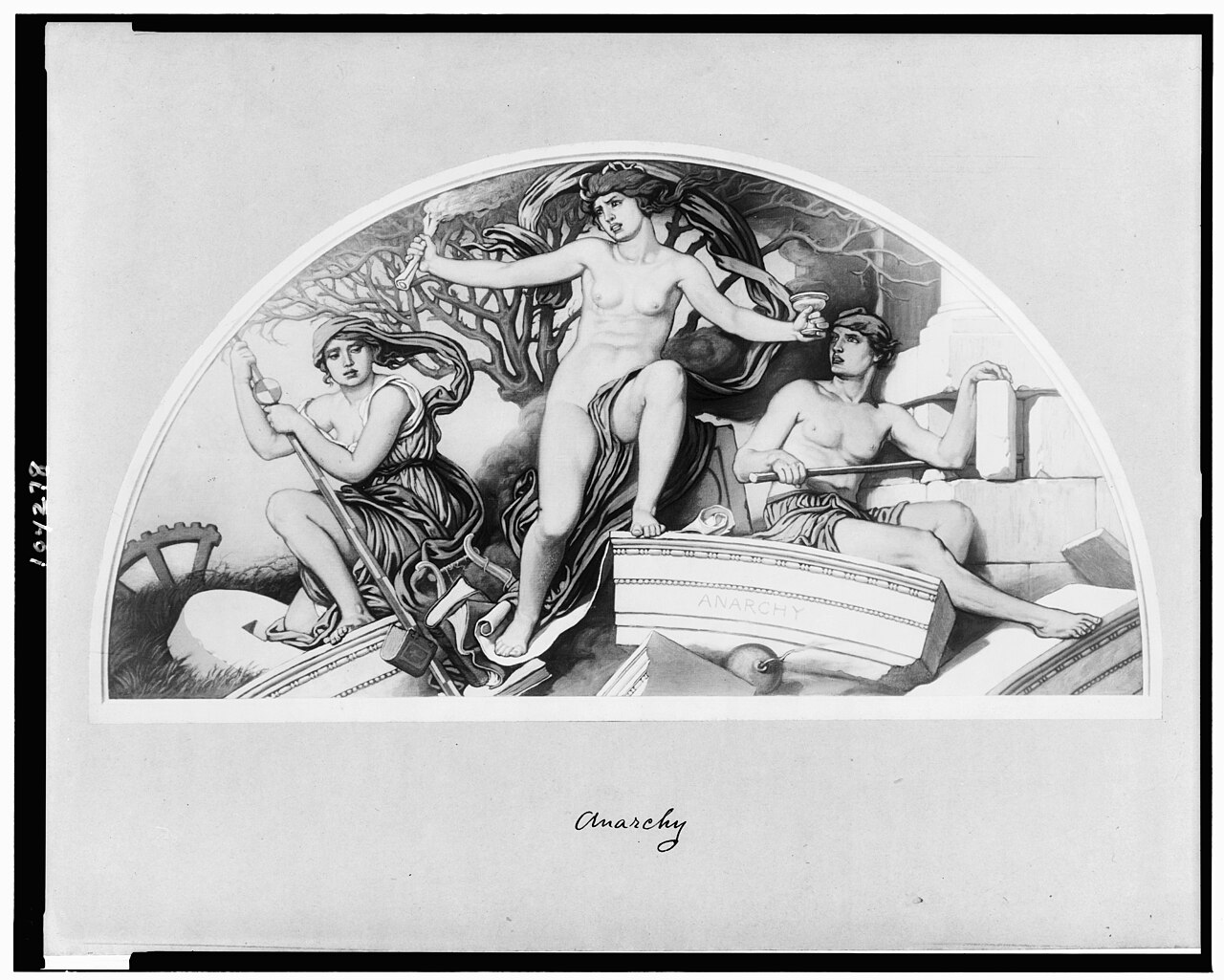
The Anarchy
A civil war over the English throne between Matilda and Stephen.

Vedder, Elihu, 1836-1923, artist · Public domain
The war caused widespread breakdown in law and order, with neither side achieving a decisive advantage for many years.
- Conflict
- Civil war
- Location
- England and Normandy
- Combatants
- Empress Matilda vs. Stephen of Blois
- Outcome
- Treaty of Wallingford; Stephen retained throne, Henry FitzEmpress recognized as successor
- Key Figure
- Empress Matilda
Lore & Background
King Henry I sought to leave the throne to his daughter, Empress Matilda, but failed to secure full noble support. Stephen's early reign saw fierce fighting with disloyal barons, Welsh rebels, and Scottish invaders.
Reader's Guide
The Anarchy is significant as a period of intense civil strife that devastated England and Normandy. The conflict was characterized by attrition warfare—sieges, raiding, and skirmishing—as castles were easily defended. However, Matilda failed to be crowned and was forced from London; Robert of Gloucester's capture led to a prisoner exchange. The war dragged on for another 11 years, with rebel barons gaining power and widespread devastation. Victorian historians coined the term 'the Anarchy' due to the chaos, though modern historians question its accuracy.
Did You Know?
- One chronicler stated that 'Christ and his saints were asleep' during the Anarchy.
The Succession Crisis That Sparked War
Among the dead was William Adelin, the sole legitimate son of King Henry I and the man designated to inherit the throne. With Adelin gone, the question of succession became fraught. Henry's only other legitimate child was his daughter Matilda, but female inheritance rights remained ambiguous in the period. Although Henry took a second wife, Adeliza of Louvain, the likelihood of another son faded, and he turned his political efforts toward securing Matilda's claim. The situation was further complicated by the marriage of Matilda to Geoffrey V of Anjou, a ruler whose county bordered Normandy and whose family was traditionally hostile to the Anglo-Norman elite. Henry's own heavy taxation to fund his wars had bred resentment among the barons, and the preceding sixty years of Anglo-Norman succession had produced no single peaceful, uncontested transfer of power.
A War of Castles and Attrition
The fighting that defined the Anarchy bore little resemblance to the set-piece battles of later centuries. Because castles of the period could be defended with relatively small garrisons, the conflict settled into a grinding pattern of sieges, raiding, and small skirmishes rather than decisive engagements. Armies on both sides were composed primarily of knights and infantry, supplemented by a significant number of mercenaries. In the opening years, neither Matilda nor Stephen could claim a clear upper hand. Matilda established her authority over southwest England and much of the Thames Valley, while Stephen held the southeast. Large swaths of the country remained in the hands of barons who refused to commit to either faction. As the war dragged on into its second decade, rebel lords in Northern England and East Anglia accumulated ever greater autonomous power, and the regions where fighting was most intense suffered widespread devastation. The stalemate persisted for over a decade, leaving the kingdom fractured and exhausted.
The Reversals of 1141 and 1142
Matilda, emboldened, pushed forward to be crowned queen in London, but hostile crowds forced her out of the city before the ceremony could be completed. The momentum then swung violently the other way: at the rout of Winchester, Stephen's wife Matilda of Boulogne captured Robert of Gloucester, Matilda's half-brother and chief military ally. The two sides agreed to a prisoner exchange, and Stephen was released. The following year, Stephen nearly repeated the feat in reverse. She escaped by crossing the frozen Thames on foot, reaching safety on the opposite bank. These rapid swings of fortune left both claimants weakened and the kingdom no closer to resolution.
The Treaty of Wallingford and the End of the Anarchy
By the early 1150s, the war-weary barons and the Catholic Church both pushed toward a negotiated settlement. The two armies met at the siege of Wallingford Castle, where the Church intervened to broker a truce and prevent open combat. Peace negotiations followed, and during them Stephen's eldest son Eustace died of illness, removing the immediate obstacle to a compromise. The resulting Treaty of Wallingford allowed Stephen to keep the throne for the remainder of his life while recognizing Henry as his designated successor. Henry then became the first Angevin king of England and embarked on a long program of reconstruction. The conflict was regarded as exceptionally destructive even by medieval standards; one chronicler lamented that 'Christ and his saints were asleep' during the period. Victorian historians later coined the label 'the Anarchy' to capture the scale of the chaos, though modern scholars have questioned whether that characterization fully holds.
Gallery





Frequently Asked Questions
Why does The Anarchy matter in English history?
It exposed how fragile the Angevin monarchy was and demonstrated that a disputed succession could plunge an entire realm into years of lawlessness. The eventual resolution helped pave the way for the stronger, more centralized Plantagenet dynasty that followed.
More in Great Collapses 1-20
Spotted an error? Know more?
This is a living reference — every entry is fact-audited, and reader corrections feed straight into our audit queue. Suggest an edit · See this site's audit record